by Chuck Quinton


Model Golf Swing |
Rotary Swing Golf |
ModelGolf Swing
- Is it One Plane or Two?
ModelGolf.com Swing Analysis
I had the
opportunity to visit the Model Golf headquarters
at Grand Cypress in Orlando and get on the model.
For those of you who aren't familiar with the
Model, visit www.ModelGolf.com to learn more.
Basically, the Model is a computer generated simulation
of a "perfect" golf swing based on analysis
of over 150 touring pros from all different tours.
They have some great technology that allows you
to see your swing overlaid with the model. I was
hitting the ball very well at the time and was
very curious to see how my swing stacked up against
the model. Below I have some screenshots of my
swing against the model from the Model Golf website.
Position 1: Setup
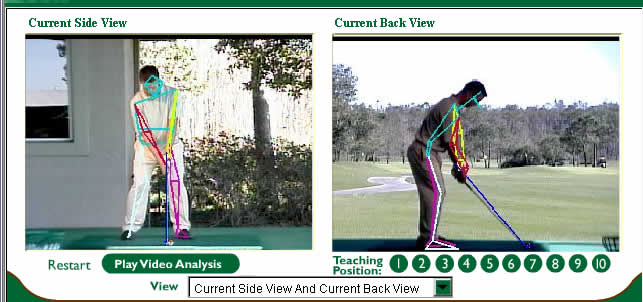
My first swings on the model did not match up with the model as they do here. These photos are after seeing my swings on the computer and making a few adjustments with the Model Golf instructor to more closely match the model. My setup was much more level and centered with less tilt away from the target - a one plane setup. As you can see from the Side View, the Model looks to have a good deal of shoulder and spine tilt away from the target creating the classical "Reverse K" setup position. This puts the hands more forward at address, whereas a one plane swing would look to have the hands more in the center of the body rather than forward toward the left thigh. From the Back View, my hands are set a bit lower at address than the model.
Position 2: Club Parallel
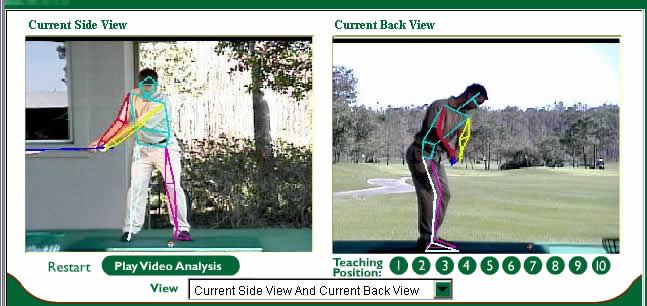
When the club reaches parallel to the ground on the backswing, the model requires that you make a pretty big shift off the ball. Coming from a one plane swing, making this lateral shift felt more like a sway. In the Back View you can also see how my one plane tendencies had me bring the club back more to the inside than the model as it is about 4 or 5 inches inside the model's club position.
Position 3: Halfway Back
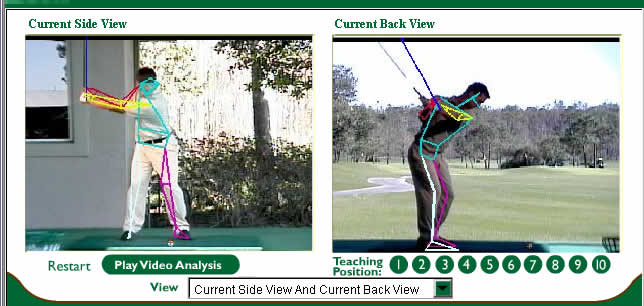
At the halfway back position, you can see the model start to lift the arms and begin to swing the club much more upright. This can easily be seen by the models shaft position here, as it points to a spot between his feet and the ball - a typical two plane swing position at this point in the swing. My one plane tendencies can be seen here again as the club is swinging more behind my body, the hands already behind the shoulder and my club shaft pointing at the ball.
Position 4: Top of the Swing
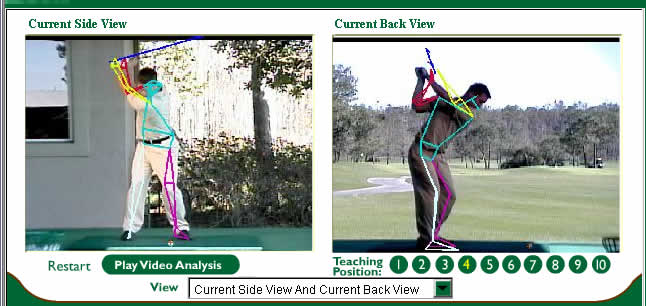
At the top of the swing, it is very clear to see that the model employs a lifting of the arms above the shoulder plane to arrive in a position that is keeping the arms more in front of the torso. My arms have swung more behind me and more on plane, although there is a slight amount of lifting in this photo as I was trying to more closely match the model with my swing. The lifting can be seen in two ways. The first is that my left arm has swung on a plane that is steeper than my shoulder plane. The second way that is a very good check for a one planer is the position of the right arm. In the one plane swing, the right arm should be perpendicular to the ground. You can see that the model's right arm is very cocked inward with the right elbow pointing well behind him. Ben Hogan's right arm in this position pointed straight down. If the right arm bends inward at the top as it does here, some amount of lifting, slight in my case and more dramatic in the model, has occurred.
Position 5: Transition
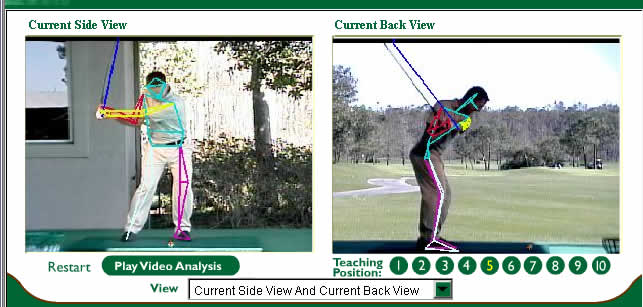
While I was trying to swing more like the model, my transition matched up fairly closely. The major difference being that I am coming in on a slightly lower plane. If you draw a line from my shaft straight down, you will see that it points directly at the ball, whereas the model is pointing slightly outside it. You'll remember during this same position during the backswing, the model's clubshaft pointed at a spot between the feet and the ball and my shaft pointed directly at the ball. Here the model is now pointing outside the ball and I am, again, pointing directly at it. This is caused by the "flattening" of the shaft during the transition in the two plane swing, where the club must be looped or flattened onto a less upright swing plane in order to make solid contact with the ball. In the one plane swing, the goal is to always be on the same plane.
I also think it is worthwhile to point out that the transition in this swing is far more aggressive than what I normally employ in my one plane swing, with a much more aggressive lateral shift toward the target. This is necessary because, in order to more closely match the model on the backswing, I had to make a fair shift off the ball away from the target. In my normal one plane swing, I like to stay a bit more centered with less lateral shift. Because I was making such an aggressive lateral move, you can clearly see in the Side View that there was a tremendous amount of force placed on the shaft causing it to bow. Before getting on the model, I thought my swing was fairly fast paced with a fast transition. After getting on the model the first time, I couldn't believe how early and quick the model made the transition move. I was being totally left behind. To try and catch up, I started going at it harder and harder and started losing some of my timing, and that is why the shaft is bowed so much. This is NOT a good thing. It's a clear sign that I was going at the ball too hard from the top and had little stored energy left at impact in my wrist cock. The reason I mention this is that I am a fairly athletic person, probably very athletic by most people's standards. I was a professional snowboard mountaineer for 3 and a half years back in my younger days (www.MountainWeb.com) and I struggled to swing at the pace of the model with any athleticism and coordination. While I did only spend an hour trying to "match up" my swing on the simulator, it was a struggle that required a lot out of me. The one plane swing, while still being athletic, does not place the same requirements on my timing or demands on my athleticism and has allowed me to play much more consistent golf shots when I haven't been on top of my game. I found that while working on a two plane swing for several years, my misses could go anywhere, or nowhere, for that matter and I believe this is a large part of the reason why.
Position 6: Club Near Parallel
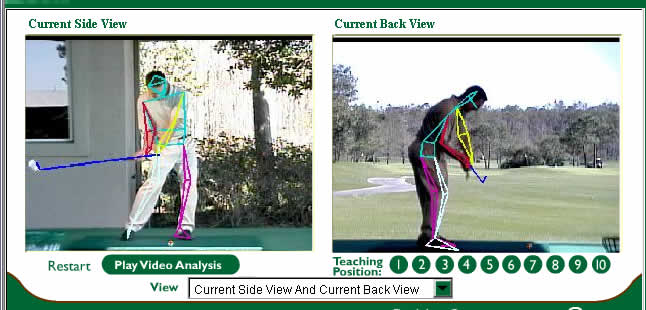
The main differences here in the two swings are that I'm a bit more inside and under the plane than the model, with my club pointing straight down the target line while the model's is outside it pointing left.
Position 7: Impact
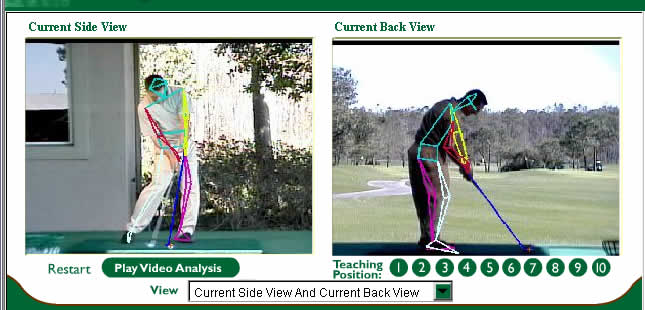
After all is said and done, the model and I end up in exactly the same place, we just go there two different ways. The Side View is a bit behind because the video camera simply was a frame or so behind, but the positions end up exactly the same. The most important thing in this photo is the back view. The left arm is straight and above the right with the right arm bent and the right forearm being perfectly in line with the shaft. This is the model impact position for any golf swing, one plane or two. I love to go back and watch old video of Ben Hogan and pause it at impact. No one ever did it better in my opinion, and he looked just like this from down the line, except he had a cool hat on.
Position 8: Finish
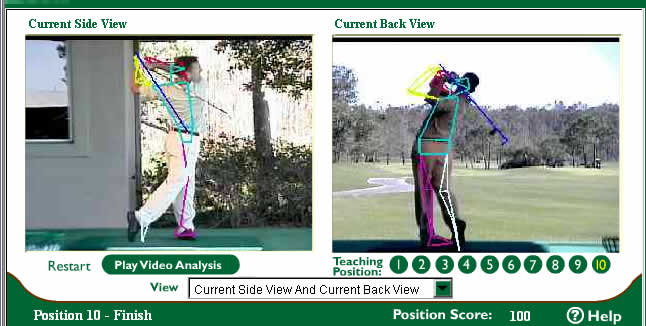
I've swung so hard on this shot that it has pulled my body well forward of the model's and the club has wrapped around me a bit much. This is much harder than I would normally swing, but I still maintained my balance and only had to go to the chiropractor for one visit to get put back into alignment :-)
- Chuck Quinton
| [an error occurred while processing this directive] | [an error occurred while processing this directive] |
[an error occurred while processing this directive]
[an error occurred while processing this directive] |