TWO PLANE GOLF SWING
Setup
The spine angle tends to be
more upright at address in a two plane swing. This erect address position
causes the shoulders to rotate on a relatively flat plane, more level
to the ground. The arms will tend to hang a bit more vertically compared
to the one plane setup where the arms will tend to be slightly further
from the body and the golfer will tend to stand closer to the ball.
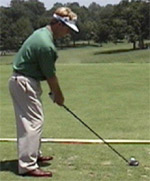
David Toms has a beautiful upright address position with his arms
dropping more straight from his shoulders. This presets them in a
positin to naturally swing more "up" on the backswing.
Backswing
The biggest difference in the
two swings is seen here. In a two plane swing the arms will swing
up on a more upright plane than that of the shoulders and the club
swings well above the plane and to the outside of the turn. In order
to do this, the left arm must disconnect from the left chest muscle
and then reconnect on the downswing. Also, there is a more pronounced
shift of the body to the right creating the need for a greater lateral
move back to the target during the transition. This shift creates
width in the backswing which is necessary because of the tendency
of the two plane swing to be too narrow with the arms swinging more
up than around.
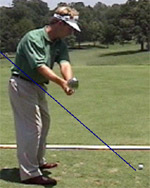
David's club has clearly traveled up above the plane very early in
the swing. His arms are now moving independently of his rotating body.
David will work to keep his arms more in front of his body throught
the swing and keeping the club working more up than around.
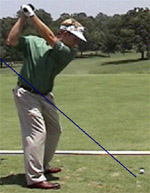
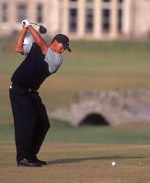
Toms is in the perfect two plane position at
the top. His arms have a long way to go to get the club back on plane.
Tiger Woods used to get in the same position at the top as seen here
in 2001, but no more. He is moving more to a one plane swing with
Hank Haney, although Haney defines a "one plane" swing differently
than Hardy. He is not concerned with the arms and shoulders at the
top of the swing, rather he is concerned with the club always swinging
back and through on the same plane, thus naturally creating a slightly
more around swing plane.
Transition
This is where things get tricky.
Swinging the arms up on a more vertical plane than the shoulders requires
that, at some point in the swing, the arms must drop back down on
plane before the rotary motion of the body can be used to generate
power by aggressively rotating back to the left. In order to do this,
there needs to be either a lateral move toward the target with the
body that gives the arms time to drop back on plane before the body
begins to clear left, or the hips must simply "wait" to
turn until the arms have dropped the proper amount. Depending on your
instructor's school of thought, you may have heard to swing your arms
down faster from the top to get them back down on plane or you may
have been told to wait and let gravity do the job, or you may have
been told to not turn the body and swing the arms back in front of
you, either way, these are two plane swing ideas. You've no doubt
seen drills that talk about dropping the right leg back at address
(for righties) so that you can slow the rotation of the hips. As you
can imagine, trying to time these moves consistently proves very difficult
over time. This places a high demand on timing and rhythm, which vary
from day to day. In a one plane swing, you will see that the inconsistencies
that are caused by this motion are far less of an issue. Not that
timing and rhythm are things that can be disregarded in either swing,
but in a one plane swing you are far less susceptible to bad golf
when your timing is a bit off.
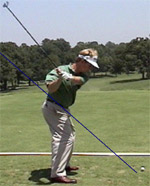
Toms is too steep to hit the ball at the target,
David will continue to "wait" for arms to fall back on plane.
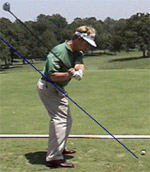
David's arms have dropped dramatically to get the club back parallel
to the plane.
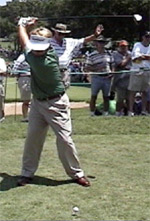
Toms "loads up" more on his right side
rather than staying more centered.
Downswing
It is critical for the arms
to drop back down on plane before the body begins to rotate back to
the left. Many two plane golf instructors teach a "looping"
motion in the swing where the club swings up on the backswing and
is then "flattened" on the downswing in order to get the
club back on the proper plane. Jim Furyk is an extreme example of
this, but most all two planers will due this to some degree. The difficulty
is getting the amount of drop correct as well as the timing of the
drop, not to mention the patience required to not "hit"
the ball from the top of the swing - where the body begins rotating
back to the left before the arms have dropped. Those that don't resist
the "hit" urge and begin rotating back to the left before
the arms drop on plane will swing "over the top" if the
arms didn't drop at all or be in a "stuck" position if the
arms didn't get back in front of the body.
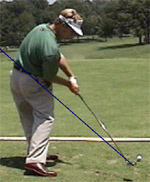
David's hands are well above the plane established at address nearing
impact and his right arm is "stuck" behind his hip, which
is actually a more classic one plane impact position that Hardy is
looking for and is very similar to where Ben Hogan was at impact.
Toms' swing is a bit unique in that he uses his body more than his
arms on the downswing than most two planers, but for most golfers,
this ball would go well right because in general, a two planer needs
to have his arms and hands more in front of his body throughout the
swing.
|
|
ONE PLANE GOLF SWING
Setup
The spine angle is more bent
over at address allowing the shoulders to rotate on a steeper plane.
This, in turn, allows the club to swing up. Ben Hogan, the classic
one planer, stood more erect at address and then swung his shoulders
on a steeper plane during his swing. Jim Hardy advocates the hands
be under or just inside the chin at address.
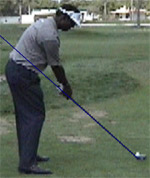
Vijay Singh has a bit steeper spine angle than David Toms and has
his arms out away from his body a bit more. This sets the golfer up
to have a more "around" swing path.
Backswing
In the one plane swing, the
arms will swing up slightly to a position where they are on plane
with the shoulders at the top of the swing. There are far fewer "moving
parts" because the left arm never leaves the chest to swing up
on a steeper plane. Because the swing is more "around" than
"up", the body may stay more to the left with less lateral
shift, if any, to the right. This reduces the need to have a large
slide back toward the target during the transition. The key in the
one plane swing is swinging the arms around behind the body rather
than lifting of the arms in front of the body. Ben Hogan advocated
that the right leg not move back at all during the backswing, keeping
the body very centered throughout the swing.
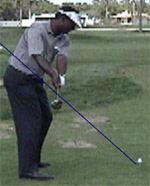
Vijay swings the club more around on a more natural swing arc. His
arms have done nothing independent here, they are simply following
his body's lead. Hardy would rather see the club closer to the right
thigh at this point with the left arm angled more in rather than straight
down the line.
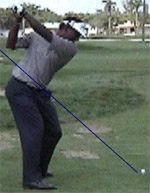
Vijay's left arm and shoulder match up very much on the same plane
at the top. But nobody matched up as well as Ben Hogan. Hogan's left
arm and shoulders were perfectly on plane, exactly parallel with each
other, while Vijay is slightly above. Note how much more upright David
Toms' body is compared to Vijay. Singh has his shoulders much more
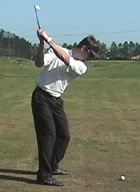
out over his toes, a trademark of the one plane swing. Below is a
picture of me at the top of the swing hitting a mid iron.
Transition
Because your arms are always
on plane and never lift, there is no need to wait for them to drop.
Your body can begin to rotate back toward the target as aggressively
as you like and the arms should simply follow. The natural instinct
at the top of the swing is to get the club head back to the ball as
fast as possible in order to strike it with authority. Of course,
this is the key detriment to swinging on two planes where you simply
must create some sort of delay during the downswing to let the arms
fall back down on plane in a position to strike the ball. Hardy points
out that in a one plane swing, all you do from the top is rotate the
body back to the left after setting your weight more on your left
side. Everything rotates together, reducing the dependency on timing
and rhythm to blend the upright swinging of the arms and the flatter
turning of the body. Unfortunately, many golfers swing their arms
"up" on the backswing and then try and rotate their bodies
back to the left as hard as they can. In essence, they are combining
characteristics of the two swings, which doesn't work and creates
the dreaded "over the top" move creating a pull slice.
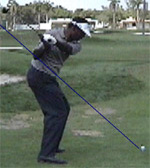
Vijay gets back parallel to the plane earlier than Toms, and then
matches up perfectly halfway down.
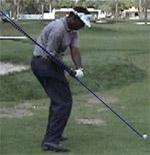
Back on plane, but Hogan never strayed far from
it. Vijay stays closer than most today.
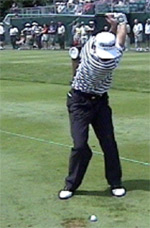
Steve Flesch's transition is one of the best
in the business. His aggressive body rotation back to the target creates
the look of him hanging on his front leg, but this is simply not true.
His body began moving back to the target before his club reached the
top of the swing, creating a tremendously dynamic position. Because
his arms are on plane, he can simply swing back to the target with
no waiting.
Downswing
In the one plane swing, the
arms, club and shoulders are already on the proper plane, allowing
the golfer the freedom to simply rotate the body back to the left.
With the left arm velcroed to the chest, the body can rotate as hard
it likes without ever worrying about trying to control the arms. It
is important that the golfer properly use his body to swing the club
and not the arms. Golfers who are accustomed to swinging their arms
to generate power often find this one of the biggest challenges. No
longer requiring the arms to try and control the club, the golfer
can do what he instinctively wants from the top of the swing - swing
hard. You'll quickly find that this swing will feel more natural,
more like hitting a baseball off a tee. A downswing mantra would be
"swing left".
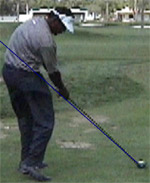
Vijay is not in a classic one plane impact position here according
to Hardy, but he has done an excellent job of returning the club to
its original position established at address. Vijay's swing, like
most golfers on tour, is a bit of a hybrid. Vijay works hard at keeping
his left arm glued to his chest throughout the swing. You've no doubt
seen him swing with a golf glove under his left arm. That is a major
key to the one plane swing and helps the body stay more in control
of the club and make a full turn on the backswing.
The principles that Jim Hardy has come up with can act as a guideline
for golfers to help understand the concept of the two swings. As you
learn more about the two swings, you will see that most professional
golfers exhibit traits from both swings, although you will benefit
from learning the principles and choosing one swing or the other.
|